
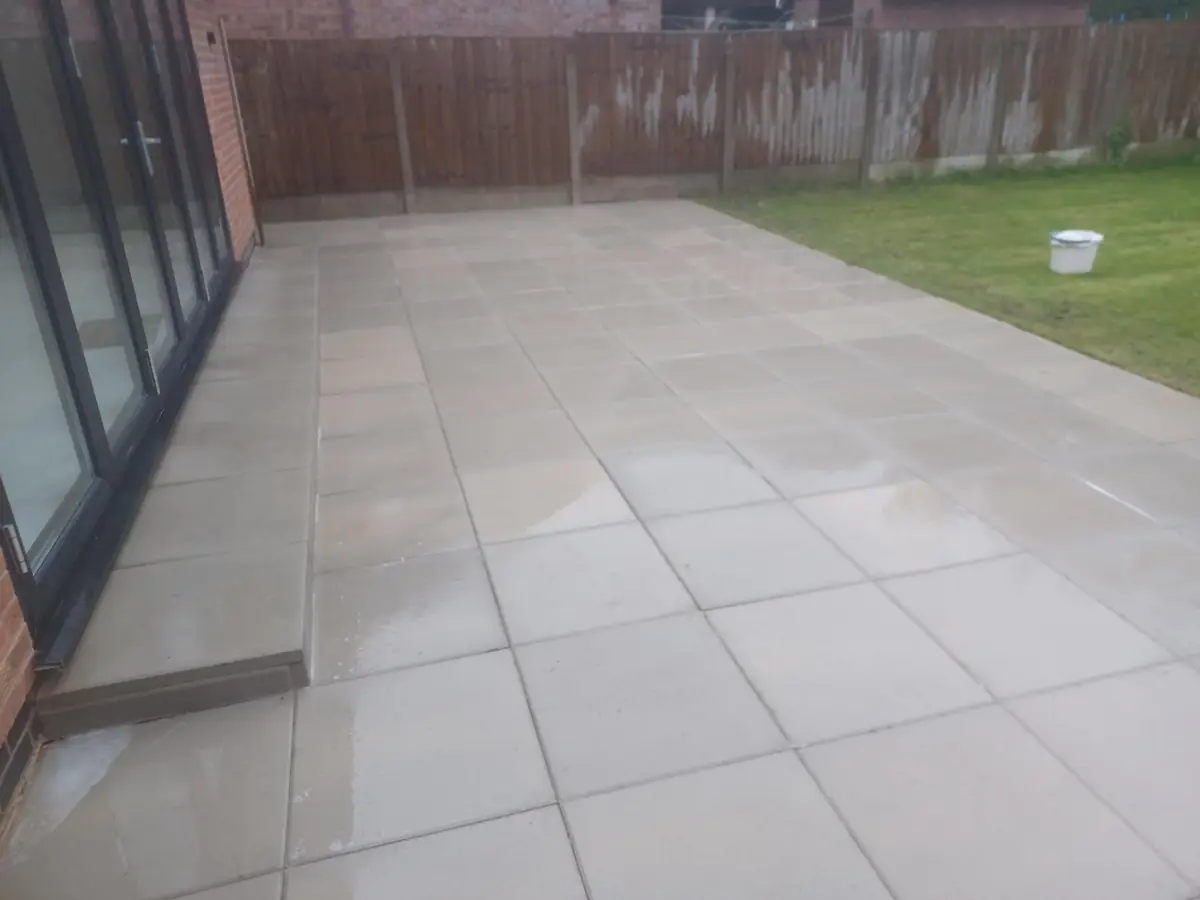
Porcelain patio cleaning is one of the easiest jobs on my round, and I’ll start with an honest correction to explain why. Porcelain paving gets talked about alongside sandstone, granite and limestone all the time. It isn’t natural stone at all. It’s a manufactured ceramic. That one difference changes almost everything about how it’s cleaned.
In this post
Is porcelain paving natural stone?
No. Porcelain paving is made from clay and minerals fired at extremely high temperatures. It’s the same basic process as the porcelain tiles in your kitchen, just made thicker and tougher for outside. It comes out of the factory at a consistent size, thickness and finish. Natural stone can’t offer that, because every quarried slab is a bit different.
That matters for cleaning. Natural stone like sandstone or limestone is porous because it formed over millions of years, with all the inconsistency that brings. Porcelain is engineered to be about as close to non porous as an outdoor surface gets. That’s not a sales line. It’s just physically what it is.
Does porcelain paving still get dirty?
Yes, don’t get me wrong. It still needs cleaning. General grime, algae film and leaf debris all still build up on it. The difference is that it sits on the surface instead of soaking in. That makes porcelain easier and faster to clean than any natural stone I deal with.
It can still get slippery once a green film forms on top, especially the smoother finishes. If that’s your worry, my post on why patios go slippery in winter covers it.
How do you clean a porcelain patio?
It’s about as straightforward as it gets. The pressure washer lifts the surface dirt and debris first. Then sodium hypochlorite goes on if there’s any algae or moss. Then the twin jet surface cleaner gives an even finish across the whole patio with no stripe marks.
Because porcelain is so dense, I don’t have the worries about pressure that I have with sandstone or slate. It comes up looking new far more easily than natural stone does. A biocide at the end slows the green coming back. There are a few porcelain jobs on my Facebook page if you want to see the before and after.
Does porcelain paving need sealing?
No, and I wouldn’t take your money to do it. Porcelain is made to be non porous, so a sealer has nothing to soak into. It just wouldn’t add anything here.
My honest advice: if anyone offers to seal your porcelain paving, ask them to explain what it’s actually for. In my experience there isn’t a good answer.
Why do the joints on my porcelain patio look dirty?
Because the joints aren’t porcelain. The slabs might be near enough non porous, but the grout or jointing compound between them is a different material. That’s where algae, moss and weeds tend to get a grip. On a lot of porcelain patios the slabs look fine and it’s the lines between them that make it look tired.
I clean the joints along with the slabs, gently, so I’m not pulling out the jointing. If any of it has failed or gone missing, I’ll tell you. That’s a repair job rather than a cleaning one. I clean porcelain patios on new builds and older houses alike, from Kirkby and Huyton to Southport. Have a look at my patio cleaning service if yours is due.
FAQs
Driveway and patio cleaning starts from £100. Porcelain tends to be one of the quicker surfaces to clean, so it often sits towards the friendlier end for its size. What changes the price is how big the patio is, how much algae is on it and the state of the joints. You won’t be paying for a sealer, because porcelain doesn’t need one. The easiest way to get a price is to send me a few photos on WhatsApp to 07469 539 068. I normally reply within about five minutes. You get 10% off for quoting that way. Or ring 0151 272 3404 if you’d prefer to talk.
Yes, nearly always. Porcelain is easy to judge from photos because there’s no hidden staining soaked into the slabs. What you see is what’s there. Send me a wide shot of the whole patio and a couple of close ups of the joints, since that’s often where the worst of it is. A short video walking round works just as well. I normally get back to you within about five minutes with a price. Quoting from photos saves me the fuel and the time of driving out just to look. That’s why you get 10% off for doing it this way.
It’s usually one of my quicker jobs for the size. The slabs don’t hold onto dirt, so the surface cleaner lifts it in one go most of the time. The joints take a bit more care, especially if moss or weeds have got into them. I’ll give you a rough idea of how long I’ll be when I quote from your photos. There’s no waiting around for a sealer to go on either. Once it’s clean and rinsed, that’s the job done. In summer it’s dry and usable again very quickly. In winter it takes a little longer to dry off.
Most of the time it comes up looking very close to new. That’s the big advantage of porcelain. The dirt and algae sit on top rather than soaking in, so once they’re lifted the colour and finish come straight back. The joints can be a different story. If the grout has stained or started to break down, a clean will improve it but may not make it look fresh. Scratches and chips in the slabs won’t change either. I’ll tell you honestly from your photos what I think it’ll look like when I’m done, so there are no surprises when it dries out.
Very unlikely on the slabs themselves. Porcelain is dense and hard, so it handles pressure washing well with little risk of surface damage. The part to be careful with is the jointing. A narrow jet aimed straight down a joint can blast out grout or jointing compound, especially if it’s old or wasn’t laid well. That’s why I use the twin jet surface cleaner on the slabs and go gently along the joints. If any of your jointing is already loose or cracked, I’ll point it out before I start. Then you can decide whether to get it repaired after the clean.
Not the ones I use. Porcelain is very resistant to most cleaning treatments because nothing soaks into it. Sodium hypochlorite kills algae and moss on the surface and rinses off cleanly. The biocide afterwards soaks into the joints and any surface film to slow regrowth. The thing to watch is plants and lawn next to the patio. I take care round flower beds, ponds and pets, and I rinse everything off properly. If you’ve got anything delicate near your patio, just mention it when you send your photos. I’ll work round it on the day and keep the spray well away from it.
Roughly once every 18 months to 2 years for most properties, because it holds up so well between cleans. Shaded patios and anything under trees may need it sooner, mainly because algae builds up in the joints. Open, sunny patios can often go longer. A regular sweep goes a long way on porcelain. Leaves and dirt left sitting on it are what feed the green film. If you keep it brushed, you might only need a proper clean every couple of years. I won’t book you in sooner than you need. My post on how often to jet wash covers the signs that it’s time.
It depends on the finish. Textured or riven effect porcelain tends to give better grip than the smooth, polished styles. Smooth porcelain can get slippery in the wet, and a film of algae on top makes it much worse. Steps and the area outside the back door are the spots to watch. Keeping it clean is the main fix, because clean porcelain is far safer than green porcelain. If you’re choosing new paving and grip worries you, ask the supplier for an outdoor rated anti slip finish. For an existing patio, a clean and a biocide treatment will sort the grip out for months.
Almost never. I run 50 metre hoses from the van, so I can usually reach a back garden down a side path or through a gate. Plenty of porcelain patios are on newer houses with side access, which makes it easy. If the only way through is the house, tell me and I’ll plan round it. I’ll need an outside tap or another water source, and the gate unlocked if you won’t be in. Moving garden furniture and plant pots off the patio before I arrive helps me get an even finish. It also means no stray marks hiding under them.
Yes, porcelain is one of the easiest surfaces to clean in poor weather. It doesn’t soak anything up, and there’s no sealer that needs dry slabs, so rain doesn’t really get in the way. I clean all year round. The only time I hold off is a hard frost. Water left on smooth porcelain can freeze into a sheet of ice, which is the last thing you want outside your back door. If the forecast looks icy for your day, I’ll let you know and move it. Otherwise a wet day is no problem for a porcelain clean, and you can use the patio again as soon as it’s dry.
Is your porcelain due a clean?
Send me some photos on WhatsApp and I’ll give you an honest price, usually within about five minutes. You get 10% off for quoting this way, and I won’t try to sell you a sealer you don’t need.
See my latest jobs on Facebook, read what customers say on Google, or watch the work on YouTube.