
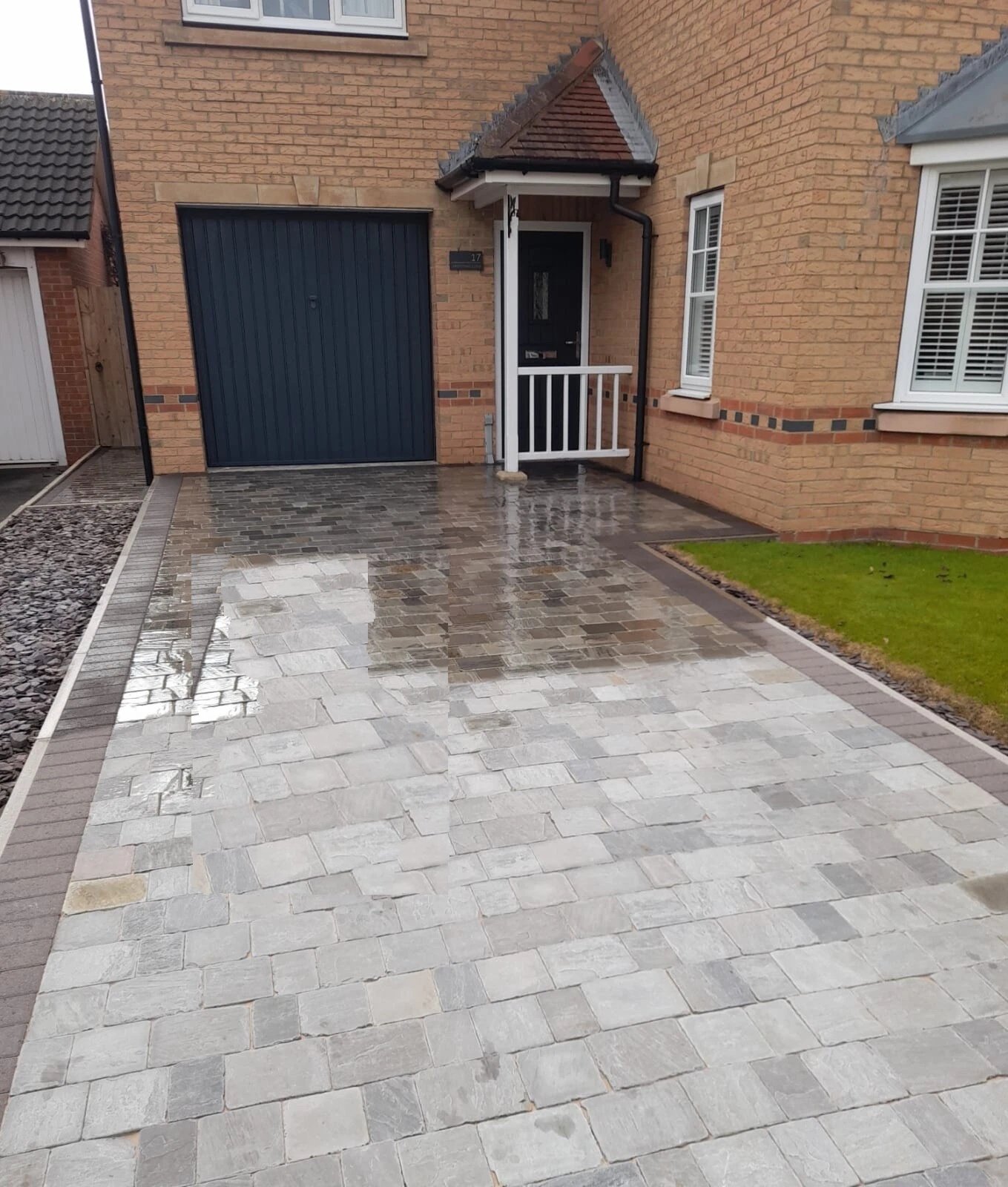
How often to jet wash a driveway is one of those questions with an honest answer and a salesman’s answer. The salesman says every six months. The honest answer is that most drives round Liverpool need a proper clean every 12 to 18 months, and some can go longer. The change creeps up on you so slowly that you only notice it when a clean strip shows you what colour the drive really is.
In this post
How often should a driveway be jet washed?
Every 12 to 18 months suits most drives across Liverpool, Wirral and Sefton. A north facing drive or one sat under trees will usually need doing every year. A sunny, open drive with good drainage can often go a fair bit longer.
That’s a guide, not a rule. I’d never tell someone to book a clean because the calendar says so. The drive itself tells you when it’s ready, and I’ll come on to the signs below.
What makes a driveway go green faster?
Shade and damp, every time. Moss and algae need moisture to get going. A drive that doesn’t see much sun stays wet for days after it rains. That’s exactly what they love.
Overhanging trees make it worse twice over. They block the light and they drop leaves that sit and rot on the surface. Hedges along the edge do the same. Poor drainage is the other big one. If water pools in the same dip every time it rains, that patch will be the first to go green.
Blocked gutters catch people out too. An overflowing gutter pours water onto the same strip of drive all winter. If you’ve got a green stripe running along the front of the house, look up. A gutter clean might save the drive as well. I’ve written about why gutters matter before winter if that sounds familiar.
Does the type of driveway change how often it needs cleaning?
Yes, quite a bit. Block paving needs the most attention because of the joints. Moss and weeds take root in the sand between the blocks, and once they’re in, they spread. Most block paved drives I see need a clean every year or so to stay on top of it.
Plain concrete is more forgiving. It still goes green and grey, but there are fewer places for weeds to hide. Tarmac tends to fade and collect dirt more than moss. Natural stone like Indian sandstone is porous, so it soaks up damp and greens up quicker than you’d think. Smoother stone like granite holds up better between cleans.
How do you know when your driveway needs cleaning?
You’ll usually spot one of these first:
- Green or black patches, especially near walls, bins and shady corners.
- Slippery spots after rain.
- Weeds or moss pushing up through the joints.
- A dull, grey look across the whole drive.
Here’s a quick test. Drag your finger or the side of your shoe across a patch. If it leaves a clean line, the drive is overdue. And if you’ve started noticing it every time you pull up, it’s probably time.
Quick tip: take a photo of your drive straight after it’s cleaned. A year later, take another from the same spot. It’s the easiest way to see how fast yours really goes, and it makes it simple to send me a WhatsApp for a quote.
Can you jet wash a driveway too often?
You can, and I see the damage from it. Every heavy blast on block paving pulls sand out of the joints. Do that a few times a year with a domestic washer and the blocks start to loosen. The weeds get even more room to grow.
Too much pressure held in one spot can also scar softer surfaces and strip the top off tarmac. That’s why I use a twin jet surface cleaner on the main area. It spreads the pressure evenly, so there are no stripes and no worn patches. If your drive needs cleaning more than once a year, the answer is usually to slow down the regrowth, not to wash it harder.
How do you make a driveway clean last longer?
Kill the growth properly in the first place. A rinse only moves the surface layer. I treat the moss and algae with sodium hypochlorite during the clean, then most surfaces get a biocide that soaks in and slows new growth for months. On block paving, fresh kiln-dried sand goes into the joints once it’s dry. That’s what stops the weeds finding a way back in. My driveway sanding page explains that step in more detail.
Sealing stretches the gap further on the right surface. Driveway sealing closes up the surface so dirt and moss have less to grip. After that it’s simple stuff. Sweep off leaves in autumn. Keep the gutters clear. Trim back anything hanging over the drive.
If you’re wondering what a clean costs before you decide, I’ve put that in my post on driveway cleaning cost. You can also see the full driveway cleaning service. I work all over, from Kirkby and Huyton to Formby. There are plenty of recent drives on my Facebook page if you want to see how they turn out.
FAQs
My driveway cleaning starts from £100. Where yours lands depends on the size, the surface and the state it’s in. A drive that’s cleaned regularly is quicker, so it tends to cost less each time. That’s one of the hidden benefits of not leaving it for five years. A drive buried under thick moss takes far longer to bring back. For an exact figure, send me a couple of photos on WhatsApp to 07469 539 068. I’ll come back with a proper price and you’ll get 10% off for quoting that way. If you’d rather talk it through first, ring me on 0151 272 3404 and I’ll happily help.
Usually, yes. Send me a shot of the whole drive and a close up of the worst bit, and I’ll tell you honestly whether it’s ready. I normally reply within about five minutes. If it looks like it can wait another few months, I’ll say so. There’s no point paying for a clean that won’t make much difference yet. If it does need doing, I’ll give you a price at the same time. Quoting from photos saves me a trip out, so you get 10% off. It also means you’re not stuck waiting in for someone to come and have a look.
That depends on the size of the drive and how long it’s been left. A drive that’s cleaned every year is a quicker job because there’s less built up. One that’s gone years without a clean has deeper moss and more weeds in the joints, so it takes longer. Access counts too. If I can park close and run the hose straight onto the drive, it’s simpler than working round gates and steps. I’ll give you a rough idea of timings when I quote. On block paving, the fresh sand goes in once everything’s dry. Sometimes that’s the same day and sometimes it’s a short visit back.
Yes, if the growth is properly killed rather than just rinsed off. Most DIY cleans only shift the surface layer. The roots of the moss and algae stay put and the green creeps back within weeks. I treat the growth during the clean so it’s dead, not just moved. Most surfaces then get a biocide that soaks in and slows new growth for months. On block paving, fresh sand in the joints does the same job by leaving no room for weeds to settle. Put together, that’s why a proper clean lasts far longer between visits than a quick blast with a hired washer.
Not when it’s done properly. The damage comes from heavy handed cleaning, not from how often it happens. A domestic washer held close to the joints blasts the sand out. Do that a few times and the blocks lose their support and start to move. I use a twin jet surface cleaner across the main area, which spreads the pressure evenly. For weeds in the joints I use a Turbo Nozzle so I can target them without wrecking the blocks. Then fresh kiln-dried sand goes back in once it’s dry. Cleaned that way, a yearly clean keeps block paving in good shape rather than wearing it out.
Sometimes. Sealing closes up the surface so dirt, oil and moss have less to cling to. On porous surfaces like natural stone and some block paving, it can stretch the time between cleans and make the next one easier. It’s not a magic shield though. You’ll still need to sweep and keep an eye on it, especially in a shady spot. If your drive is in full sun and stays fairly clean anyway, I’d honestly save your money. Sealing has to go on a clean, dry surface. So it’s always done after a clean, and in winter it can mean waiting for a dry spell.
Block paving usually needs it more often. The joints between the blocks are the problem. They hold damp and give moss and weeds somewhere to root. Most block paved drives I look after need a clean every year or so to stay on top of it. Plain concrete has no joints for weeds to hide in. It still goes green and grey in the shade, but many concrete drives can go 18 months or more. Tarmac sits somewhere in between and tends to collect dirt and fade more than it grows moss. In every case, shade and trees shorten the gap. Sun and good drainage stretch it.
Almost always. I run 50 metre hoses from the van, so I can usually park on the road and still reach the far end of a long drive. That also helps on terraced streets where there’s no space right outside. I don’t need to come through the house to get to a front drive either. If access is tight, like a narrow side path, a gate or a shared drive, mention it when you send your photos and I’ll plan around it. You don’t need to be home, as long as I can get onto the drive. Just move any cars off it beforehand so the whole surface gets cleaned in one go.
Any time apart from a hard frost. Plenty of people book in spring so the drive looks good for summer, and that works fine. Autumn and winter are just as good if the drive has gone slippery, because that’s when moss and algae grow fastest. The only weather I avoid is a freeze, because water left on the surface can turn to ice. Rain doesn’t stop the clean itself. It does matter for sanding and sealing, as both need a dry surface. Booking outside spring also tends to get you a date sooner. If you want the longer version, I’ve written about whether winter is a good time for exterior cleaning.
Yes. I’m based in Fazakerley and I clean driveways right across Liverpool, the Wirral and Sefton, including Southport. That takes in places like Crosby, Maghull, Kirkby, Huyton, West Derby, Woolton, Wallasey, Birkenhead and Heswall. I run H2o Restored with my son. There are two vans out across the area most days. If you’re not sure whether I reach your street, send your postcode on WhatsApp and I’ll tell you straight away. Send a couple of photos with it and you’ll get a price at the same time. You can see recent jobs on Facebook and read what customers think on my Google reviews.
Think your driveway might be due?
Send me a couple of photos on WhatsApp and I’ll tell you straight whether it needs doing now or can wait. I normally reply in about five minutes, and you get 10% off for quoting that way. Prefer a chat? Ring me on 0151 272 3404.
See my latest jobs on Facebook, read what customers say on Google, or watch the work on YouTube.