
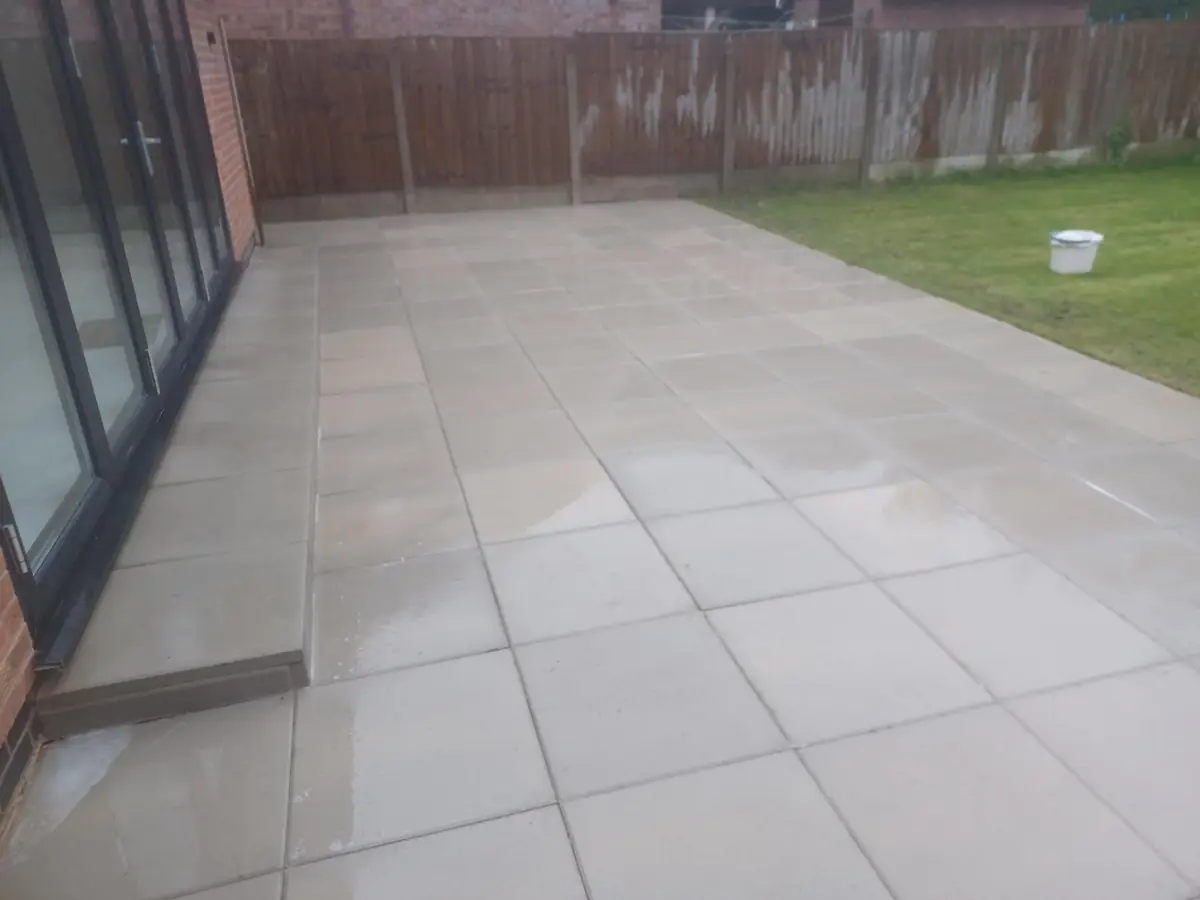
Every winter I get the same call. Someone’s nearly gone over on the back patio putting the bins out, and now they’re worried about the kids or an older parent doing the same. If your slippery patio turns into an ice rink the minute it rains, you’re not imagining it. There’s a simple reason for it and it can be fixed.
In this post
Why do patios go slippery in winter?
It’s algae. That thin green film on the slabs is a living layer that feeds on damp and shade. Winter in Liverpool gives it plenty of both. The sun sits low and the days are short. The slabs barely dry out between showers. When it’s wet, that film behaves like a coat of washing up liquid.
Moss in the joints and black spot lichen don’t help either. Moss holds water against the edge of every slab, so the joints stay wet long after the rest has dried. I’ve written more about why winter is when the grime really grows if you want the longer version.
Which patios are the most slippery?
North facing gardens are always the worst I see. So is anything under trees or hemmed in by high fences. Riven stone is worse than smooth because the textured face holds water and gives algae more to grip. Indian sandstone is the classic example round here. It’s porous, it’s everywhere and it goes green faster than almost anything.
Smooth porcelain can still get slippery but it cleans up far more easily. If you’re not sure what you’ve got, my guide to porcelain paving explains the difference.
Can you stop a patio being slippery yourself?
Yes, up to a point. A stiff brush goes further than people think. Sweep off leaves regularly because a pile of wet leaves sat on a slab for a week is basically a greenhouse for algae. Keep gutters and downpipes clear so water isn’t pouring onto the same corner every time it rains. If yours are overflowing, my post on gutter cleaning before winter is worth a read.
A domestic pressure washer will take the worst off the top. Blasting the surface doesn’t kill what’s living in the pores of the stone, though. It tends to come back within weeks. Go steady on soft stone too. Holding the nozzle in one spot can mark it for good.
Quick tip: never use rock salt on natural stone to deal with green slabs. It can stain and break down the surface. If it’s ice you’re worried about, a proper grit is the safer option.
How do you fix a slippery patio properly?
I start by clearing debris and lifting the loose dirt. Then the slabs get a treatment that kills the algae, moss and spores at the root rather than just rinsing off the top layer. After that I go over the whole patio with a twin jet surface cleaner. It gives an even finish without the stripes you get from a handheld lance.
Joints get cleaned out and re-sanded once everything’s dry where that’s needed. On porous stone I’ll usually suggest sealing afterwards because it slows the next lot of growth right down. You can see what a full clean actually shifts in my post on what professional patio cleaning removes, or have a look at my patio cleaning service.
How do you keep a patio from going green again?
Nothing stops algae forever, not in Liverpool weather. What you can do is slow it down. A biocide treatment, a sweep after leaf fall and sealing on porous stone will keep most patios safe through the winter. If yours is in a shaded spot, a clean every year is about right. Sunnier gardens can often go longer.
I clean patios right across the area, from West Derby and Woolton to Crosby and Southport. There are before and after shots of recent jobs on my Facebook page if you want to see the difference.
FAQs
It’s almost always algae. A thin green film builds up on the slabs in damp and shaded spots, and it turns slick the moment it gets wet. You might not even notice it in summer because the stone dries out quickly. In winter the slabs stay damp for days at a time, so the algae spreads and the surface stays greasy. Moss in the joints and black spot lichen make it worse. The joints hold water against every slab. If you rub the surface with your thumb and it feels soapy, that’s the algae, and it’s what needs killing rather than just washing off.
Yes. I clean patios all year round, and winter is often when people need it most because that’s when slabs are at their most slippery. The only time I hold off is during a hard frost. Water from the clean can freeze on the surface and create the very problem you’re trying to fix. A cold but dry day is fine to work in. Rain doesn’t stop the clean itself either. It just means re-sanding or sealing gets left for a dry spell, since those need the joints and slabs to dry out properly first. I’ll always tell you honestly if the weather means it’s worth waiting a week.
Only for a short while. Pressure washing on its own strips the green off the top of the slabs, so the patio looks great for a few weeks. The algae living in the pores of the stone survives, though, and it grows straight back. That’s why so many people jet wash every spring and wonder why it’s green again by autumn. To stop it coming back quickly you need a treatment that kills the growth at the root. I apply one as part of every patio clean. Done that way the finish lasts far longer and the slabs stay safer to walk on through the damp months.
On porous stone like Indian sandstone, yes, it’s usually worth it. A sealer soaks into the surface and closes up the pores that algae and moss love to get into. That slows down the regrowth and makes the next clean much easier. It won’t stop growth completely, and I’d be lying if I told you otherwise. You’ll still need to sweep and keep on top of it. On porcelain or smooth stone I often tell people to save their money, because there’s very little for a sealer to soak into. I’ll give you an honest view on your patio before suggesting it.
Most back garden patios are done in a few hours. A small patio might take a couple of hours from setting up to packing away, while a large garden with steps and paths can take most of a day. The size matters, but so does how bad the growth is and how easy access is for the hoses. I run 50 metre hoses from the van, so I rarely need to come through the house. Re-sanding, if your joints need it, happens once everything is dry. That’s sometimes on the same day in summer, but in winter it’s usually a short return visit.
Driveway and patio cleaning starts from £100. The final price depends on the size of the patio, the type of stone, how much growth there is and whether you want re-sanding or sealing added. The quickest way to get an exact figure is to send me a few photos or a short video on WhatsApp to 07469 539 068. I normally reply within about five minutes. Quoting this way saves me driving out to look, which is why you get 10% off. If you’d rather talk it through, give me a ring on 0151 272 3404 and I’ll be happy to help.
Used properly, a diluted cleaning treatment is safe for most patios and it’s a big part of why a professional clean lasts. The problem comes when people use strong household bleach neat, or leave it on too long. That can mark some stone and harm nearby plants and lawns. I match what I use to the surface and rinse it off properly afterwards. I also take care around flower beds, ponds and pets. Some stones like limestone need a gentler approach, and I’ve covered that in my limestone guide. If you’re unsure about anything near your patio, just mention it and I’ll work around it.
You can help a lot with a stiff yard brush and some regular sweeping. Clear leaves and debris every week or two through autumn and winter, because wet leaves sitting on slabs feed the algae. Trim back overhanging branches to let in more light and air. Make sure gutters and downpipes aren’t overflowing onto the patio. Scrubbing with hot water and a stiff brush will lift some surface algae too. Be realistic though. Without killing the growth it will come back, and in a shady Liverpool garden that can be quick. These steps slow it down rather than stop it for good.
For most patios round here, once a year is about right. Shaded gardens, patios under trees and north facing spots usually need a clean every year without fail, and sometimes a top-up treatment in between. Sunny, open patios can often go eighteen months or more. The best time to book depends on why you want it done. If safety is the worry, getting it cleaned before or during winter makes sense because that’s when slabs are most slippery. If it’s about looks for the summer, spring works well. I’ll always tell you honestly if yours can wait another few months.
Yes. I’m based in Fazakerley and I clean patios right across Liverpool, the Wirral and Sefton, including Southport, Crosby, Formby and Maghull. I also cover places like Kirkby, Huyton, Aintree and Ormskirk. If you’re not sure if I cover your street, send me a message with your postcode and I’ll let you know straight away. I’m out across Merseyside every day of the week. You can read what customers say about the work on my Google reviews and see before and after photos on Facebook. Most jobs can be booked within a week or two, and sometimes sooner if I’ve had a cancellation nearby.
Want your patio safe again before the worst of winter?
If your patio’s become a hazard, don’t wait for someone to go over on it. Send me a few photos on WhatsApp for a price, usually within about five minutes, and get 10% off for quoting that way.
See my latest jobs on Facebook, read what customers say on Google, or watch the work on YouTube.