
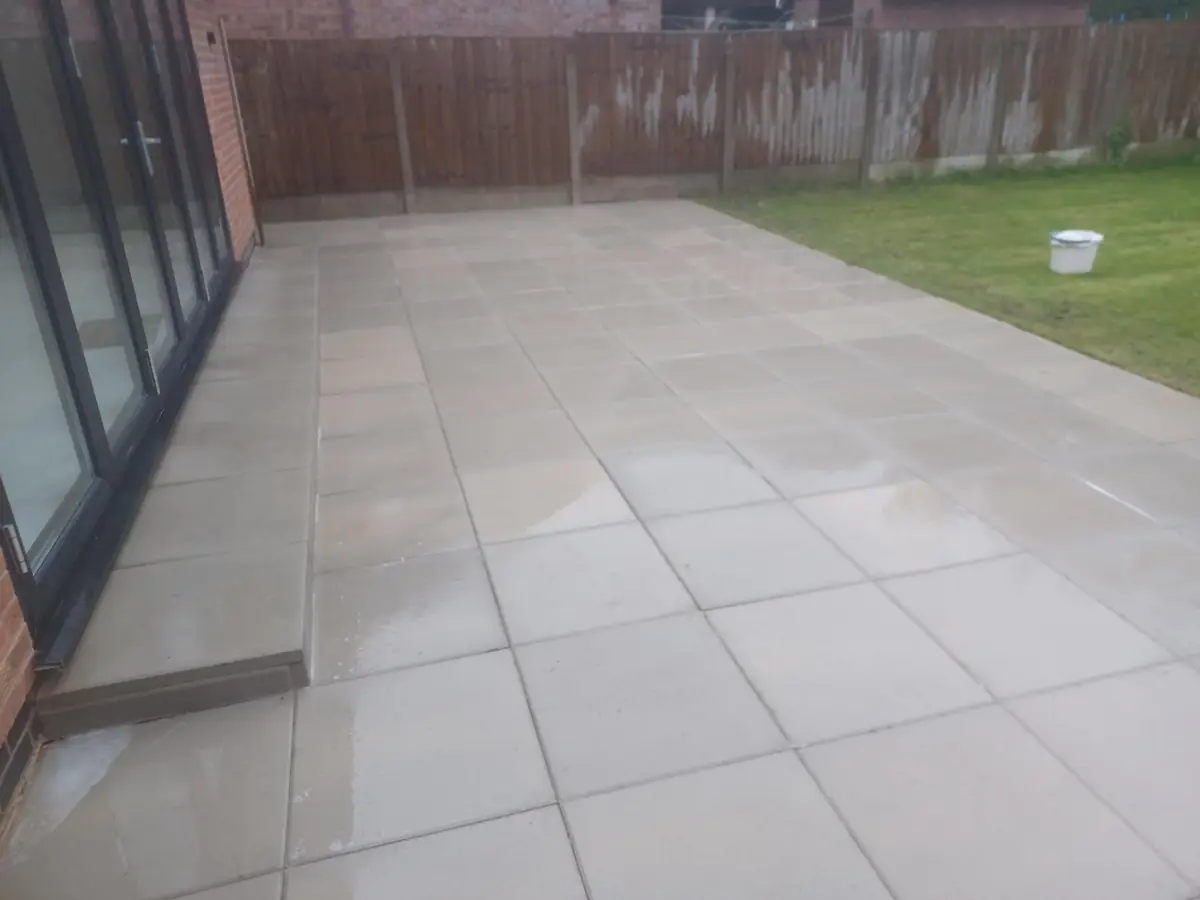
Limestone patio cleaning makes me think harder than any other job on my round. I’ll be upfront about why. Limestone reacts with acid in a way most paving doesn’t, and that changes what I’ll put on it. It also changes what I tell you to keep off it. So here’s the honest version, starting with the bit that catches most people out.
In this post
Why is limestone so hard to clean?
Because it reacts with acid. Limestone is mostly calcium carbonate, and calcium carbonate and acid don’t get on. That includes things you wouldn’t think of as acidic. Rainwater is slightly acidic. Plenty of cleaning products are. Even leaves and plant matter rotting on the surface can cause a reaction.
Over time that can lead to etching. It’s a dulling or pitting of the surface, and no amount of cleaning brings it back. It’s actual chemical damage to the stone, not dirt sitting on top.
How can you tell if a limestone patio is dirty or etched?
Wet it. Dirt and algae usually look darker and patchier when wet, and the patch feels slimy or gritty. Etching looks like dull, flat areas that have lost their smooth finish. You can often feel a slight roughness compared to the stone around it. Rings from plant pots and splash marks round a drink spill are classic etch marks.
If you’re not sure, send me a photo. I’d rather tell you what I think before I start than have you expect a clean to fix something it can’t.
Does acid rain really damage limestone?
Yes, slowly. I know it sounds dramatic. With limestone it’s a genuine factor in a way it isn’t with most stone. Urban pollution and years of rain can very gradually etch the surface. It won’t ruin your patio overnight. It’s a slow thing over many years. It’s still part of why I take more care with limestone than with granite, which is far more chemically stable.
How do you clean limestone without damaging it?
By keeping acid off it completely. I avoid harsh acidic cleaning products entirely on limestone. Sodium hypochlorite is fine for killing algae and moss because that’s not an acid issue. Anything acid based, I steer well clear of.
Before you DIY: read the label on any patio cleaner before it goes near limestone. A lot of the “brick and patio” products sold in DIY shops are acid based, and they’ll etch limestone the first time you use them.
The clean itself starts with the pressure washer to lift debris. Then the twin jet surface cleaner gives even coverage with no stripes. I keep the pressure sensible because limestone can be softer than people expect. It’s similar territory to Indian sandstone in that way. You can see what a careful patio clean looks like on my Facebook page.
Does limestone need sealing?
Yes, I’d really recommend it here. A good quality sealer puts a barrier on the stone that helps protect against staining. It can also reduce the impact of acid exposure over time. It’s not a total shield. Nothing is. On a stone with a known chemical weak spot, sealing does more real work than it does on something like granite.
What does limestone paving look like?
Pale and creamy, usually. Think cream, ivory and soft grey. It’s often honed to a smooth, almost matte finish rather than the riven texture you get on sandstone. That smooth, pale surface shows up dirt and dulling far more than a darker, textured stone would.
I look after limestone patios from Crosby to Wallasey. If you’ve got the dark, layered stuff instead, my post on slate patios is the one for you.
FAQs
Driveway and patio cleaning starts from £100. Limestone tends to take a little longer than tougher stone because I keep the pressure down and won’t use anything acid based to speed things up. Size, the amount of algae and whether you want it sealed all change the final figure. The best way to get a real price is to send a few photos on WhatsApp to 07469 539 068. I normally reply within about five minutes. You get 10% off for quoting that way because it saves me driving out to look. If you’d rather talk, ring me on 0151 272 3404 and I’ll go through it with you.
Often, yes, especially if you send a couple of close ups. Take one dry and one after you’ve splashed it with water. Dirt and algae tend to show darker when wet. Etching stays dull and flat because the polish has been eaten off the surface. Rings under plant pots, marks near the barbecue and patches where something was spilled are the usual giveaways. I’ll tell you honestly what I think I’m looking at. If it’s etching, I’ll say so before you book, so you aren’t paying for a clean expecting it to fix something it can’t. Sometimes it’s both, and I’ll explain which parts will improve.
It depends on the size and how much growth there is. Limestone isn’t a job I rush. I keep the pressure sensible and let the treatment do some of the work rather than blasting it off. That means it can take a little longer than the same size patio in granite or porcelain. I’ll give you a rough idea of time when I quote from your photos. If you want it sealed, the slabs have to be completely dry first. In damp weather that often means sealing on a second visit. I’d rather come back than seal wet stone and waste your money.
If the dullness is dirt, it usually comes up lovely. The pale cream and grey tones show through again once the algae and grime are lifted. If the dullness is etching, a clean won’t bring the shine back, because the surface itself has changed. That’s chemical wear rather than dirt, and it’s beyond what a pressure washer can fix. Most patios I see are a mix of both. The dirty areas clean up and the etched patches stay flat. I’ll tell you honestly from your photos what I think yours will look like when it’s done, so you aren’t surprised when it dries.
Sodium hypochlorite for killing algae is fine on limestone. That’s not an acid issue. What you want to avoid is acidic cleaning products, which react with the calcium carbonate in limestone and damage it. That’s why I’m so careful about what goes on it. The trouble is that people grab whatever patio cleaner is on the shelf, and plenty of them are acid based. Some strong rust and cement removers are too. If you’re going to clean it yourself, check the label every time. If it says acid anywhere, keep it well away from your limestone. When in doubt, ask me before you use it.
Often it’s rust rather than algae. Metal garden furniture, plant pot stands and old fixings can leave orange marks as rain runs off them onto the stone. That needs a different approach to a standard algae clean, and it’s a tricky one on limestone. A lot of rust removers are acid based, which is the last thing you want on this stone. So I’ll look at the marks first and tell you honestly what I think can be done before I touch them. Moving metal furniture onto feet or pads is the best way to stop new marks appearing in the first place.
Roughly once a year for most properties. That’s similar to Indian sandstone. Shaded spots and patios under trees may need more frequent attention because algae gets going faster in the damp. Open, sunny patios can sometimes go a bit longer. Keeping on top of it also matters more with limestone than most stone. Leaves and plant matter left to rot on the surface can react with it, so a regular sweep through autumn helps protect it. A sealer makes cleans easier and buys you more time between them. I’ll tell you honestly if yours can wait rather than booking it in early for the sake of it.
It can be, particularly the honed, smooth finishes. Honed limestone has less natural grip than a riven stone, and a film of algae on top makes it far worse. Back doorways, steps and the path to the bins are the spots to watch. Keeping it clean is the main thing you can do. Once the algae is gone, most limestone is safe enough to walk on in the wet. Sweeping regularly helps it stay that way. If you’ve got older family members or kids running about, it’s worth sorting before winter, when the stone stays damp for days. My post on slippery patios in winter has more on that.
Almost always. I run 50 metre hoses from the van, so I can usually get to the back down a side path or through a gate without coming through the house. If the only access is through the house, tell me and I’ll plan round it. I’ll need an outside tap or another water source, and the gate unlocked if you won’t be in. Tell me about your access when you send your photos. Moving plant pots and furniture off the patio before I arrive helps a lot too. It also lets me see if there are any rust or etch marks hiding underneath them.
Yes, the clean itself is fine in winter. I work all year round. The only time I hold off is a hard frost, because water left on the surface can freeze and make it dangerous. Sealing is where the weather matters more. Limestone has to be properly dry for a sealer to soak in, and that’s harder to get in the colder months. So I’ll often clean in winter and come back to seal on a dry spell. If the forecast looks wrong for your day, I’ll tell you and move it. I’d rather wait a week than rush a stone this fussy.
Has your limestone lost its shine?
Send me a few photos on WhatsApp and I’ll tell you honestly what’s achievable. That might be a full clean and seal, or if there’s etching, what you can realistically expect. You get 10% off for quoting this way.
See my latest jobs on Facebook, read what customers say on Google, or watch the work on YouTube.