
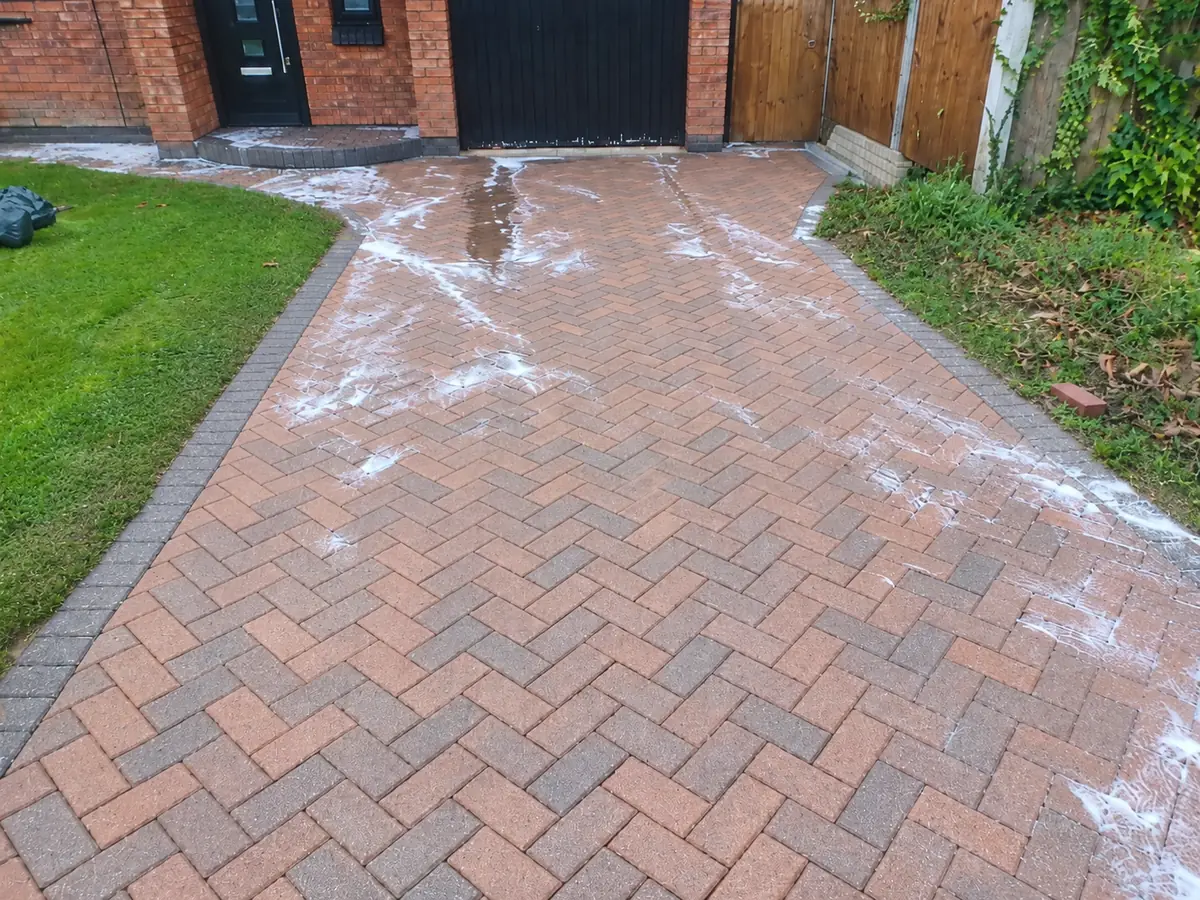
York stone cleaning doesn’t come up half as often for me as Indian sandstone. When it does, the stone behaves quite differently under the pressure washer. It’s tougher and it’s kinder to work on. But there’s one thing about York stone that gives me more trouble than any other paving I clean. Here’s how I approach it.
In this post
What is York stone?
York stone is a sandstone quarried in Yorkshire, mostly from round Leeds and Bradford. It’s dense and hard wearing with that classic honey grey British look. You’ll know it from old town squares and the front paths of Victorian houses. A lot of what’s laid today is reclaimed rather than freshly quarried, and that history changes how I clean it.
Is York stone better than Indian sandstone?
For staying clean, yes. York stone is denser and less porous than Indian sandstone, so it doesn’t hold water in the surface the same way. That means less algae, less green and a slower build up of dirt. It’s not immune. Nothing outdoors in Liverpool weather is. But I clean York stone driveways less often than Indian sandstone ones of a similar size and age.
It’s also more forgiving under pressure. Being harder, there’s less risk of surface damage if someone’s a bit heavy handed with it. That puts it somewhere between sandstone and granite, which is about as tough as paving gets.
Can old stains be removed from reclaimed York stone?
Some can and some can’t. This is the bit of York stone that gives me the most grief. A lot of what gets called York stone round here was salvaged from old buildings, pavements or demolition sites. Some of it’s beautiful and full of character. It often comes with decades of ground in oil, tar and old paint that new stone would never have.
Old oil and historic staining isn’t a quick fix. Sometimes it needs a stain treatment left to sit before I pressure wash. Even then, some of it has gone so deep into the stone that it won’t fully come out. I’ll always tell you honestly if that’s the case rather than promise a result I can’t give you.
Worth knowing: if you’re buying reclaimed York stone for a new patio, look at the slabs wet before you pay. Rain brings out old oil and tar marks that you can’t see when the stone is dry and dusty.
How do you clean York stone?
It’s the same core process as any driveway clean, but I can be more confident with the pressure than I would on softer sandstone. First the pressure washer clears loose debris. Then sodium hypochlorite deals with any algae or moss. Then the twin jet surface cleaner goes over the whole area for an even finish with no stripes.
Old reclaimed slabs often have worn, open joints full of build up. The Turbo Nozzle sorts those out without much risk to the stone itself. A biocide goes down at the end to slow the regrowth. There are before and after shots of stone like this on my Facebook page if you want to see what’s possible.
Does York stone need sealing?
No, it’s optional rather than essential. York stone’s lower porosity means it doesn’t desperately need a sealer to survive. Sealing does make it easier to keep clean and it helps resist new staining. That matters more if the stone is already carrying some history from before it was ever cleaned.
I clean York stone across the patch, from the older terraces in Woolton to houses in Birkenhead and right across the Wirral. If you’re weighing up a new patio instead, my post on porcelain paving covers the easiest surface of the lot to keep clean.
FAQs
Driveway and patio cleaning starts from £100. The final figure for York stone depends on the size, the state of the joints and whether there’s old staining that needs a separate treatment. Reclaimed stone with oil or tar marks takes more work than a clean, newer patio. Sealing is extra if you decide you want it. The quickest way to get a proper price is to send photos to me on WhatsApp at 07469 539 068. You get 10% off for quoting that way. If you’d rather talk it through first, ring me on 0151 272 3404 and I’ll be glad to help.
Usually I can give you a good idea, yes. Send a wide shot of the whole area and a few close ups of the marks you’re worried about. If you can, take one with the stone wet, because water shows up oil and tar far better than dry dust does. From that I can normally tell you whether it’s algae and grime that will lift easily or old staining that’s gone deep. I normally reply within about five minutes. If I’m not sure, I’ll say so straight. I’d rather give you a cautious answer than promise you a perfect finish and let you down on the day.
It depends mostly on size and on how much staining needs treating. A straightforward patio with just algae and dirt goes quicker because the stone is hard and takes the surface cleaner well. Reclaimed slabs with oil marks take longer. The stain treatment has to sit for a while before I wash it off, and the joints often need clearing out properly. I’ll give you a rough idea of how long I’ll be when I quote from your photos. If you want sealing as well, the slabs have to be fully dry first, so that’s often done on a separate visit.
In most cases, yes. Under the grime, York stone usually still has that warm honey grey colour people buy it for. Once the algae and dirt are lifted, it tends to come back looking far brighter than owners expect. The exceptions are deep oil, tar or paint marks on reclaimed slabs, which may fade rather than disappear completely. Some old stone also has natural weathering that’s part of its character and won’t change. I’ll be honest about what I think yours will look like before I start, so the result isn’t a surprise to you on the day. You’ll see the real colour once the slabs have dried out.
No. York stone is a hard, dense stone and it handles a proper clean well. Even reclaimed slabs that are a hundred years old are usually tougher than new Indian sandstone. The thing to watch is the joints rather than the stone. Old mortar can be crumbly and loose, and a narrow jet aimed straight at it can pull it out. I keep the pressure sensible around old joints and use the surface cleaner on the slab faces. If any of your joints are already failing, I’ll point it out from the photos so you can decide whether to get them repointed afterwards.
It’s usually efflorescence. Mineral salts in the stone work their way to the surface as new slabs dry out and leave a white bloom behind. It’s very common in the first year or two after laying and it isn’t damage. It normally fades by itself as the salts run out. I’d leave sealing until it’s settled, because sealing over it can trap the salts in. A clean will often take some of it off, but it may come back for a while until the stone has dried right through. Send me a photo if you’re not sure what you’re looking at.
For most properties every 18 months to 2 years is about right. That’s less often than Indian sandstone because York stone doesn’t soak up water and algae in the same way. Shaded gardens and patios under trees will need it sooner. Open, sunny ones can go longer. Sweeping off leaves through autumn and keeping gutters from overflowing onto the stone both help stretch the time between cleans. The biocide I use after a clean also slows the regrowth for months, which gives you a good head start. My guide on how often to jet wash a driveway has more on judging when yours is due.
It can be, especially once algae has built up on it. Clean York stone has a decent natural grip. A green film on top turns it slick the moment it rains. Steps, front paths and the area outside the back door are where I see people get caught out most. If anyone in the house is unsteady on their feet, it’s worth keeping on top of it before winter. A clean and a biocide treatment will sort the grip out for months and make the steps safe again. My post on cleaning in winter explains why that’s often the best time to get it done.
Usually, yes. I carry 50 metre hoses, so I can normally reach a back garden from the van down a side path or through a back entry. A lot of York stone is on older terraced houses, and they’re the trickiest for access. Most still have an alleyway at the back I can use. I need an outside tap or another water source, and the gate unlocked if you won’t be in. Tell me about your access when you send your photos. I’ll work out the easiest route before I turn up so there’s no messing about on the day.
Yes, cold weather on its own doesn’t stop me. I clean all year round. The only time I won’t do it is a hard frost, because water left on the stone can freeze and make it more dangerous than before. Rain doesn’t affect the clean much either. It does affect sealing, because the stone has to be properly dry for a sealer to soak in. So in the colder months I’ll often clean first and come back to seal when there’s a dry spell. If the forecast looks wrong for your job, I’ll let you know and move it to a better day.
Want an honest view on your York stone?
Send me a few photos on WhatsApp and I’ll give you a price and a straight answer on what will come out, including telling you if some old staining won’t fully shift. You get 10% off for quoting this way.
See my latest jobs on Facebook, read what customers say on Google, or watch the work on YouTube.