
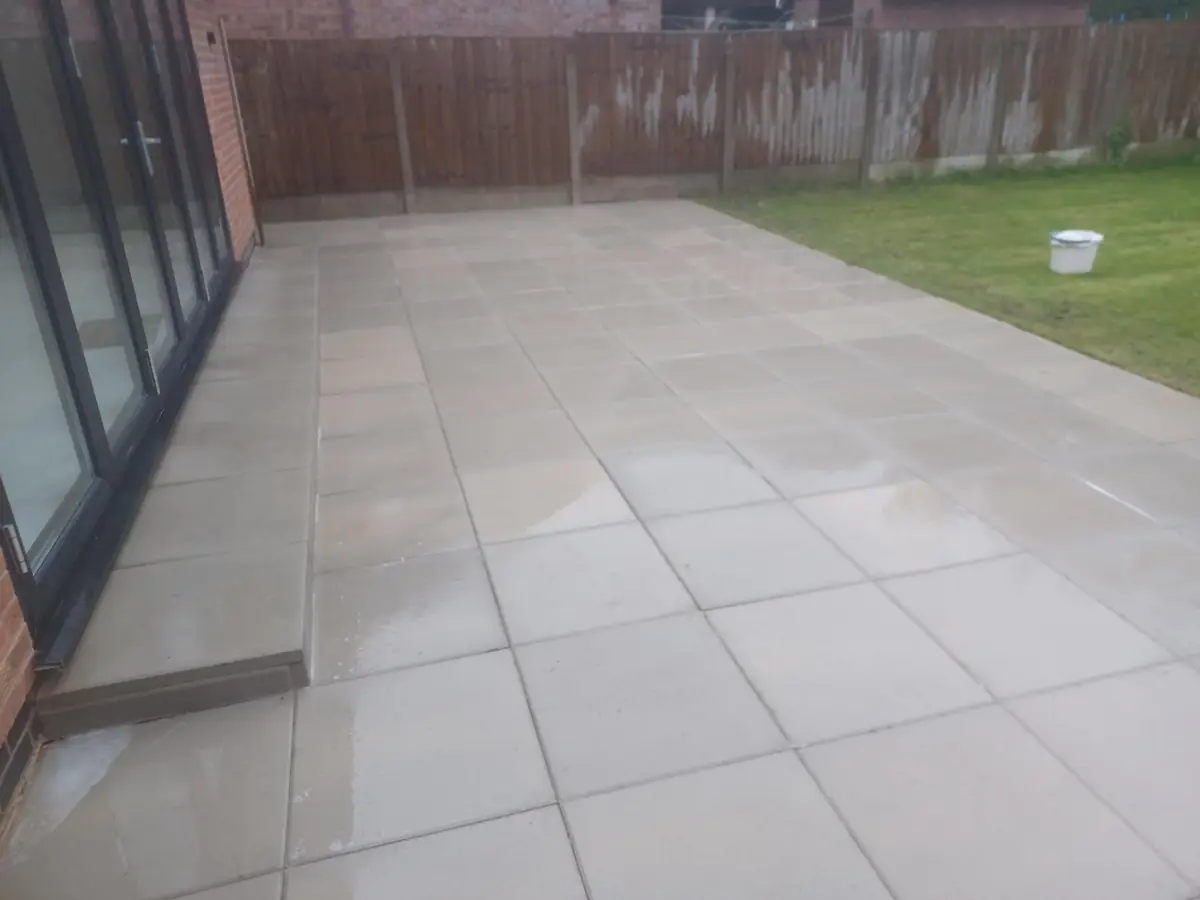
Indian sandstone cleaning is the job I do more than any other in Liverpool. The stone is everywhere. You’ll find it on driveways and patios right across the city, and it comes with its own set of habits. I’ve got very used to them over the years. So here’s what’s actually going on with your sandstone and what I do about it.
In this post
What is Indian sandstone?
It’s a natural sedimentary stone, quarried mostly in Rajasthan. You’ll see it sold in raj green, autumn brown, kandla grey and a few other shades. Most of it is riven paving. That means the face has a natural split texture rather than being dead flat.
That texture gives it character. It also holds onto dirt and moisture in a way a flatter surface never would. That’s a big part of why I’m called out to it so often.
Why does Indian sandstone go green so fast?
Because it’s porous and Liverpool is wet. The stone soaks up rain and holds it in the surface long after a denser stone would have dried. Add shade from a fence or a north facing garden and you’ve got the perfect spot for algae and moss. The green you see is algae feeding off that damp.
I see this on driveways that are barely two years old. It’s not a sign anything’s gone wrong with the laying. It’s just what this stone does if it’s left alone. If you want to compare, York stone is the same family of rock but far denser, so it greens up much more slowly.
What are the black marks on Indian sandstone?
Usually a mix of algae and general grime that’s worked its way into the pores. You’ll mostly find it in the low points where water sits after rain. It looks worse on the lighter shades like autumn brown. A rinse won’t shift it because it’s not sat on top. It needs killing and lifting out of the stone.
How do you clean Indian sandstone without damaging it?
Gently, with the right kit. I start with the pressure washer to lift the loose dirt and debris. Then the slabs get sodium hypochlorite where it’s needed. That kills the algae and moss at the root instead of just blasting the top layer away.
After that I go over it with a twin jet surface cleaner. Two rotating jets give even coverage with no stripe marks. That matters on a stone this soft because a single jet wand leaves lines very easily. For stubborn build up in the texture I might use the Turbo Nozzle. I’m careful with it on sandstone though. Too much pressure in one spot can start eating into the surface.
You’ve probably heard the horror stories. Someone’s mate did the driveway and now it looks patchy. That’s nearly always pressure held in one place for too long on a stone that can’t take it. Once the clean is done, a biocide goes on and soaks in to slow the regrowth for months. Have a look at my Facebook page for before and after shots of sandstone I’ve brought back.
Is it worth sealing Indian sandstone?
Yes, for this stone I think it is. Because it’s so porous, a decent sealer makes a real difference to how long it stays clean. It also makes the next clean easier. It won’t stop algae forever. Nothing does that. It slows things right down and stops staining soaking into the stone itself.
Quick tip: never seal sandstone that hasn’t been cleaned first. Sealing over dirt just locks the problem in underneath. Get it cleaned, let it dry out fully, then seal.
I wouldn’t say the same about every paving type. Some really don’t need it, and I’d rather tell you that than take your money.
How often should Indian sandstone be cleaned?
Once a year keeps most sandstone driveways round here looking right. If yours is shaded, north facing or near trees, you might need it every 8 months. Patios in sunnier, open spots can sometimes stretch to 18 months. It really depends on the spot. My post on how often to jet wash your driveway goes into the general rule.
That’s why I always ask for photos before quoting rather than guessing off a postcode. I clean sandstone everywhere from West Derby to Maghull. If yours turns out to be something smoother, my guide to limestone patios might be the one you need.
FAQs
Driveway and patio cleaning starts from £100. Where your job sits above that depends on the size of the area and how far the algae has got into the stone. Sealing is extra if you want it. I don’t like guessing a price off a postcode because two sandstone patios on the same street can be completely different. One might get full sun and the other might sit under a sycamore all year. The quickest way to a real number is a few photos sent on WhatsApp to 07469 539 068. You get 10% off for quoting that way because it saves me the drive out. Prefer to talk? Ring 0151 272 3404.
Stand back and take one or two wide shots so I can see the whole area. Then take a couple of close ups of the worst bits, like the black patches in the low spots or the green along the fence line. A short video walking round it works just as well. I normally reply within about five minutes. If there are steps, a path down the side or a tight gate, get those in the shot too. It helps me work out where the hoses go. From that I can give you a fixed price and an honest view on whether sealing is worth adding for your stone.
It depends on the size and how bad the growth is. A small back patio is a much quicker job than a big driveway with steps and borders. I’ll give you a rough idea of time when I quote from your photos so you’re not left guessing. Sandstone takes a bit longer than harder stone because I keep the pressure sensible and let the treatment do some of the work. Rushing it is how stone gets marked. If you want it sealed as well, that can’t happen until the slabs are fully dry. In damp weather that usually means coming back on a second visit.
Most of the time it comes back looking close to how it did when it was laid. The colour comes up and the green and black lifts out. What I can’t promise is a perfect result on very old staining that’s soaked deep into the pores for years. Some of that fades rather than vanishing. Raj green and kandla grey tend to hide old marks better than the lighter autumn brown. I’ll tell you honestly from the photos if I think anything won’t fully shift. I’d rather be straight with you up front than have you disappointed on the day when the slabs dry out.
Yes, if it’s done badly. Sandstone is soft enough that a narrow jet held in one place can wear away the surface and leave it patchy. That’s where most of the horror stories come from. Done properly, with a twin jet surface cleaner and sensible pressure, it’s perfectly safe. The surface cleaner keeps the jets moving all the time and spreads the force evenly across the slab. I also let the sodium hypochlorite kill the growth first so I’m not relying on brute force to get it off. If you’ve had it damaged by someone before, send me a photo and I’ll tell you what can be done.
That’s usually efflorescence. It’s salts coming up through the stone as it dries out, and it leaves a white chalky bloom on the surface. It’s common on newer sandstone and it isn’t dirt or damage. It tends to settle down by itself over the first year or two as the salts work their way out. I’d hold off sealing while it’s still happening, because you don’t want to trap it under a sealer. If it’s still showing after a couple of years, mention it when you send your photos. I can have a look and tell you whether it’s efflorescence or something else.
A bit, yes. Lighter shades like autumn brown show black staining much more obviously, so people tend to call me sooner. Raj green and kandla grey hide some of it. The algae is still there either way, though. It’s just harder to spot until the slabs start going slippery. That’s worth knowing if you’ve got the darker colours and the patio looks fine but feels greasy underfoot. Rub a slab with your thumb after rain. If it feels soapy, the algae is there whatever colour the stone is. If yours is getting slippery in the wet, my post on why patios go slippery in winter explains what’s happening and how I deal with it.
With a proper clean and a seal, most sandstone stays looking sharp for 12 to 18 months before you’d notice it creeping back. Without sealing it comes back quicker, especially in shade. The biocide I put down after the clean soaks in and slows regrowth for months, which buys you a good head start. You can help it along by sweeping off leaves and keeping gutters from overflowing onto the slabs. Wet leaves sat on sandstone for a week will start it greening up again. I’ll always tell you honestly when I think yours is due rather than booking you in too early.
Almost never. I run 50 metre hoses from the van, so I can usually reach a back patio down a side path or through a gate. Terraced houses with no side access are the only time it gets tricky. Even then there’s usually a back entry I can use. If the only way through is the house, just say and I’ll protect the floors. Mention your access when you send your photos and I’ll plan round it. You don’t need to be in while I work, as long as I can get to an outside tap or you’ve left the gate open for me.
Yes. I clean sandstone all year and winter is often when people want it doing because the slabs get so slippery. The clean itself is fine in cold or damp weather. The only time I hold off is a hard frost, because water left on the surface can freeze and make things worse. Sealing is different. The stone has to be properly dry for a sealer to soak in, so in winter I’ll usually clean first and come back to seal on a dry spell. If the forecast looks wrong for your job, I’ll tell you and move it. I’d rather wait a week than do it badly.
Got Indian sandstone that’s gone green?
Send me a few photos on WhatsApp and I’ll give you a price, usually within about five minutes. You get 10% off for quoting that way because it saves me the fuel and the time of driving out just to look.
See my latest jobs on Facebook, read what customers say on Google, or watch the work on YouTube.