
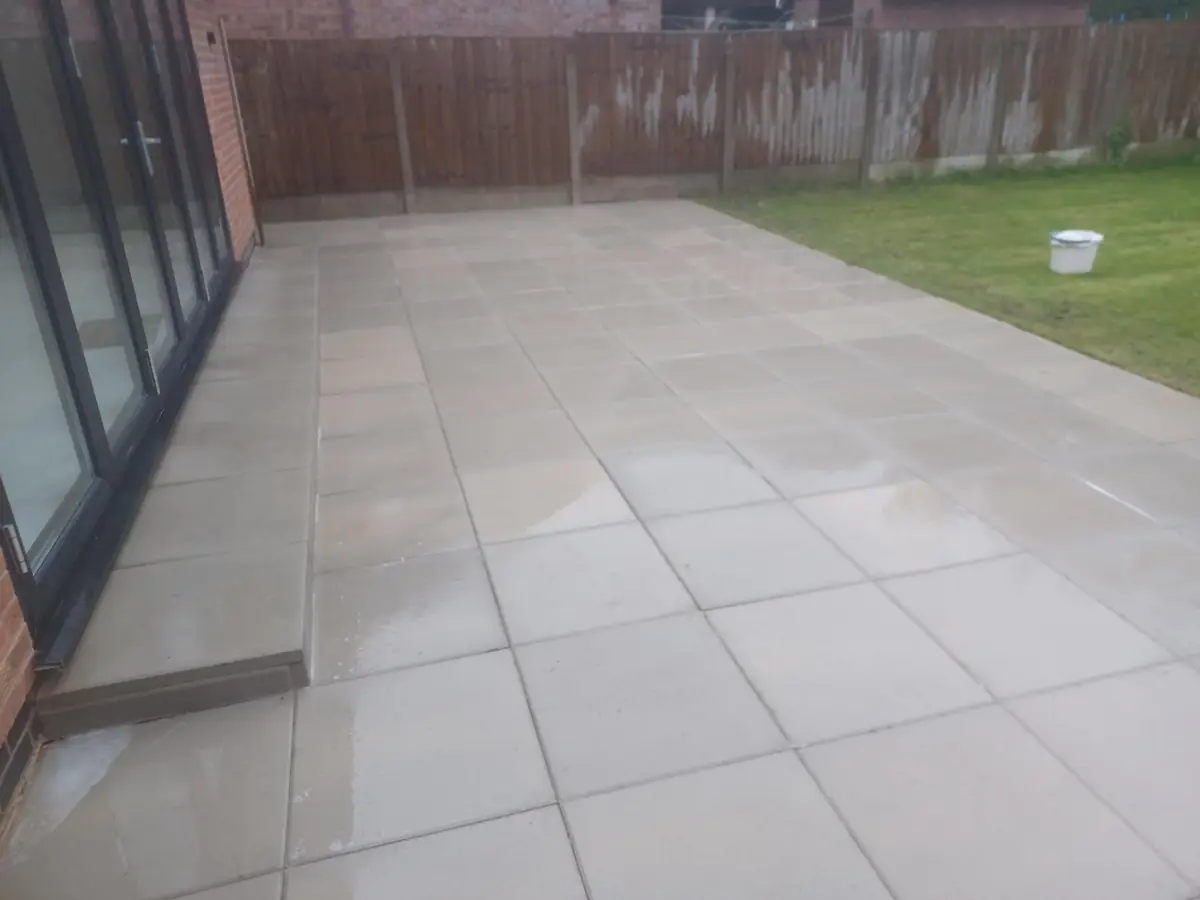
Professional patio cleaning gets asked about a lot by people who’ve already had a go themselves. Hiring a pressure washer for the weekend can make a patio look better for a while. A proper clean goes a lot further, and it lasts a lot longer. Here’s what actually comes off your slabs when I clean them, and why the finish holds.
In this post
Does professional patio cleaning get rid of algae?
Yes. The green film on your slabs is algae and it’s the first thing to go. A domestic washer blasts the top layer off but rarely kills the spores sitting in the stone. That’s why it creeps back within weeks. I put a treatment down first that kills the algae, moss and organic growth during the clean. Then the surface cleaner lifts it all away.
If your main worry is the patio turning into an ice rink every winter, I’ve written a separate post on why patios go slippery. This one is about what actually gets removed.
Can black spot lichen be removed from a patio?
Mostly, yes. Those stubborn black dots are lichen. They bond tightly to the stone and won’t shift with a garden hose. They often survive a domestic jet wash too. The treatment breaks them down so they can be lifted off, and the biocide afterwards carries on working on anything left behind.
I’ll be honest with you though. On some older or very porous stone, black spot can leave a faint shadow even once it’s dead. It fades over the following weeks as the weather gets to it. Indian sandstone is the one I see this on most. If yours is badly covered, I’ll tell you what to expect before I start rather than after.
Quick tip: try scraping one of the black dots with a coin. If it doesn’t budge, it’s lichen and no amount of scrubbing on your own will shift it. If it flakes off, it’s probably just dirt.
Does jet washing remove moss and weeds between slabs?
It does, and this is where a lot of the difference shows. Moss between the slabs traps water and lifts the jointing over time. Weeds push their roots right down between them. I clear the growth and flush the joints out. On block paving I use a Turbo Nozzle, which blasts weed roots out of the joints rather than just snapping the tops off.
Once it’s dry, the surface is ready for fresh sand or pointing where it’s needed. On block paving I brush kiln-dried sand back into the joints. That’s covered on my re-sanding page. If you want the stone sealed afterwards to slow the next lot of growth, have a look at driveway and patio sealing.
Is professional patio cleaning better than hiring a pressure washer?
Usually, yes, and it’s not just about pressure. Surface type, nozzle choice, technique and aftercare all matter. Getting those right is the difference between a patio that looks good for a season and one that stays clean for a lot longer.
A hired washer with a lance tends to leave stripes, because you can’t keep the nozzle the same distance from the slab the whole way across. I use twin-jet surface cleaners. They give an even finish with no stripes. The machines are commercial 5000 PSI units with 50 metre hoses, so I can reach the back garden without coming through the house. More pressure isn’t the point though. Knowing when to back off is. Soft stone like limestone needs a much gentler hand than granite.
How long does a professional patio clean last?
Far longer than a DIY blast, because the growth is killed rather than just rinsed off. After the clean, a biocide goes down and soaks into the stone. It keeps working for months and slows the regrowth right down. How long it stays clean after that depends on shade, trees and how damp the spot is.
I clean patios right across Liverpool, Wirral and Sefton, including Southport. You’ll see the vans in Formby, Wallasey and Huyton most weeks. There are before and after photos of recent patios on my Facebook page, or you can read more on my patio cleaning service page.
FAQs
Driveway and patio cleaning starts from £100. Where your patio lands depends on its size, the type of stone, how much growth is on it and whether you want extras like re-sanding or sealing. A small courtyard patio with light algae is at the bottom end. A big garden with steps, paths and years of black spot will cost more. The quickest way to get an exact figure is to send me photos or a short video on WhatsApp to 07469 539 068. I normally reply within about five minutes. You get 10% off for quoting that way, because it saves me driving out. If you’d rather talk, ring 0151 272 3404.
A few photos and a rough idea of size is plenty. Stand at one end of the patio and take a wide shot so I can see the whole area. Then get a couple of close-ups of the worst bits, like black spot, moss in the joints or green corners. If there are steps, paths or a side passage you want doing too, include those. A short video walking across it works just as well. Tell me roughly what stone it is if you know. If you don’t, that’s fine, I can usually tell from the photos. Send it all on WhatsApp and I’ll come back with a price, normally within about five minutes.
Most patios are done within a day, and a lot of them in a few hours. The time depends on the size, the stone and how much growth is on it. Heavy black spot or thick moss in every joint takes longer than a light layer of algae. The treatment needs a bit of time to work before the surface cleaner goes over it. If re-sanding is needed, that happens once the patio is properly dry, so in winter it can mean a short return visit. I’ll give you an idea of timings when I send the price. You don’t have to be in for the whole job either.
It’ll look a lot closer to new than you’d expect, but I won’t promise a brand new patio. Algae, moss and dirt come off, and the stone’s real colour comes back. That surprises most people, especially when it’s been green for years. What a clean can’t do is fix cracked slabs, worn edges or stone that’s faded from decades in the sun. Black spot on porous stone can also leave a faint mark at first, which fades over the following weeks. If I think your patio won’t come up the way you’re hoping, I’ll tell you before you book. I’d rather do that than leave you disappointed.
It can if it’s done badly, which is why technique matters more than pressure. Holding a lance too close or in one spot can etch soft stone and blow out the joints. That’s the damage I see most often after a DIY job. I use twin-jet surface cleaners that keep the jets at a steady distance from the slab, so the clean is even and controlled. I also change the approach for each stone. Limestone and some sandstones need a lighter touch than granite or porcelain. If a slab is already loose or cracked, I’ll point it out before I start so nothing comes as a surprise.
No, not when it’s used properly. The treatment I put down to kill the algae and moss is matched to the job and rinsed off as part of the clean. I take care around flower beds, lawns and ponds, and I’ll cover or wet down anything delicate near the edge of the patio. Pets should stay inside while I’m working and until the patio has been rinsed and dried a bit. If you’ve got a pond, a vegetable bed or anything else you’re worried about, mention it when you send the photos. I’ll plan the job around it. Most people never notice any effect on the garden at all.
Not always. It depends on what your patio is and what the joints are like. Block paving almost always needs fresh kiln-dried sand brushed back in once it’s dry, because the clean flushes the old sand and muck out of the joints. Slab patios with mortar pointing usually don’t need sand at all. If the pointing is already cracked or missing, I’ll tell you, since that’s a repair job rather than cleaning. When I give you the price I’ll say whether re-sanding is needed and include it. That way you’re not surprised with an extra cost on the day. Sealing is a separate option on top.
For most patios round here, once a year is about right. Shaded gardens and patios under trees usually need it every year without fail. Sunny, open patios can often go longer. The biocide I put down after the clean slows the growth for months, which helps a lot. Sealing porous stone slows it further still. A regular sweep, especially through autumn, also makes a big difference. If yours looks fine and you’re just wondering, send me a photo and I’ll tell you honestly whether it needs doing. If it can wait another few months, I’ll say so. There’s no point paying for a clean you don’t need yet.
Very rarely. I run 50 metre hoses from the van, which reaches the back garden on almost every house without coming through. A side gate or a back alley is all I need. If the only way to the garden is through the house, let me know and I’ll work out the best route for the hoses. If there are parked cars, bins or garden furniture in the way, it helps to have those moved before I arrive. You don’t need to be home for the whole clean, as long as the gate’s open. I’ll message you when I’m finished so you can come and have a look.
Yes, light rain doesn’t stop a patio clean. The water is all coming from the hoses anyway, so a bit of drizzle makes no difference to the result. Heavy rain is fine for the clean too, but it does hold up anything that needs a dry patio afterwards. Re-sanding and sealing both need the stone and joints to dry out first, so those may be left for a dry spell. The weather I avoid is a hard frost, because water from the clean can freeze on the slabs. If the forecast looks bad for your booking, I’ll ring you and sort out a better day rather than do half a job.
Want your patio looking like it did when it was laid?
If your patio’s covered in green, black spot or weeds, send me a few photos on WhatsApp. I normally reply within about five minutes and you get 10% off for quoting that way.
See my latest jobs on Facebook, read what customers say on Google, or watch the work on YouTube.